The Togetherness Village

I am Dr. Fadlurin Badawi. Retired professor. Lifelong student of what makes societies stand — and what makes them fall.

Let me say something clearly, because it matters:

The Togetherness Village is not idealism. It is reality.

It is not a beautiful dream held up against an ugly world. It is not utopia. It is not a picture on a wall. It is what actually happens when equity and justice stop being words and start being lived.

Idealism is when you talk about these things. Reality is when you build them.

We are building them.

This is what the village is — clearly, plainly, in full:

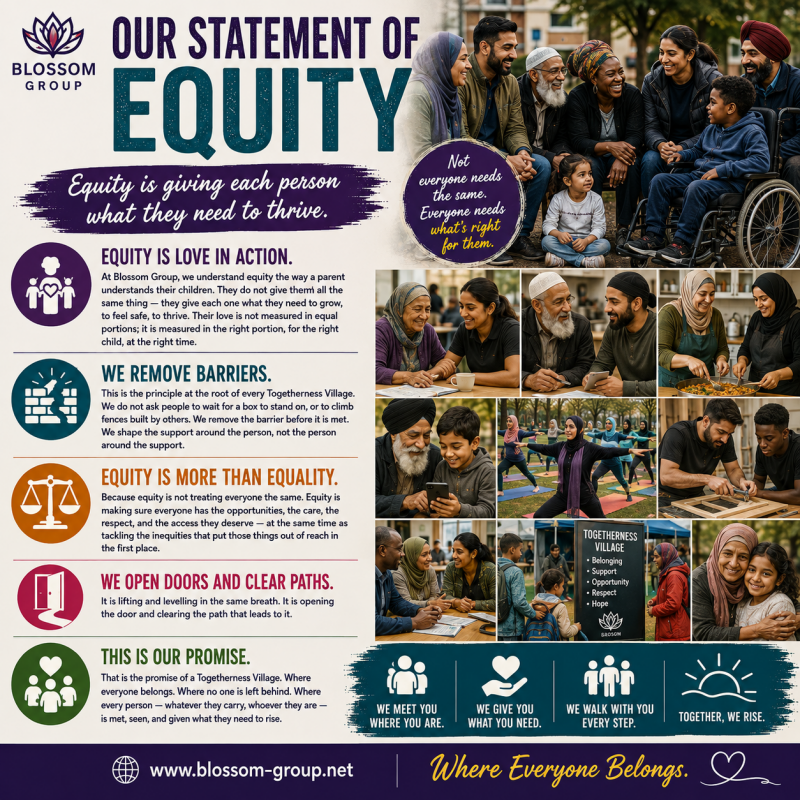
  • Equity is real here. Everyone stands on the same ground from the moment they walk through the door. No one has to earn their place.
  • Justice is real here. Fairness is not something we promise for later. It is how we treat each other now.
  • Opportunity belongs to everyone. Not to a few who climb while the rest are told to wait. The child, the elder, the newcomer, the long-time resident — the same doors are open to all.
  • There is no discrimination. Not because we have declared it forbidden, but because we meet every person as a whole human being before we meet them as a category.
  • We feel each other's pain. Not politely. Not from a distance. The way family does — because your suffering is my suffering, and your relief is my relief.
  • We lift each other up. No one is stepped over. No one pulls the ladder up behind them. When one struggles, others move toward them. When one rises, we rise together.
  • We are beyond the isms. Beyond racism, ableism, ageism, sexism, classism — beyond every wall built to make some of us count more than others. Inside this village, those walls do not stand.
  • The world is not a competition here. Outside, we are taught life is a race with winners and losers. Here, we are unlearning that lesson.
  • Wisdom is everywhere. In the child, the elder, the newcomer, the one society has ignored. We do not import wisdom and hand it out. We recognise the wisdom already sitting in every chair.
  • We care for each other — actively, practically, daily. Care is not a feeling. It is hands, a meal, a lift home, a listening ear, a name remembered, a chair pulled up.
  • We build the services that make this real. Health checks. Language support. Wellbeing. Cultural celebration. Storytelling. Poetry. Music. Games. Whatever the village needs, the village builds.

This is what people mean, or should mean, when they say community.

And this is why I insist: the Togetherness Village is not idealism. Idealism is what you fall back on when reality has failed you. What we do here is reality — the reality that emerges the moment we stop excluding, stop ranking, stop competing, stop pretending some people matter more than others, and start actually living as though every human being belongs.

Come and see for yourself. Pull up a chair. Bring who you are, bring what you carry, bring whoever needs to feel less alone.

The seat was always yours.

— Dr. Fadlurin Badawi
Blossom Group

What is It?

What Is It?

It is not a service.
It is not a drop-in.
It is not a token gesture of inclusion.
It is not idealism.

It is reality — the reality that emerges when equity and justice stop being words and start being lived. A community-led social care innovation, a healing intervention, and a cultural powerhouse — all rolled into one, powered by the people society often forgets.

The Village is built on a foundation of:

  • Equity and justice as lived reality — not slogans, not aspirations, but the ground everyone stands on the moment they walk through the door
  • Trauma-informed care — because we feel each other's pain, and no one is asked to hide what they carry
  • Culturally responsive practice — meeting each person as a whole human being before any category
  • Epigenetic understanding of social stress and generational trauma — recognising that the pain people carry did not begin with them, and neither does the healing
  • Co-production and participatory design — because wisdom is everywhere, in every chair, and the village is built by the village
  • Health equity and intersectionality — beyond the isms; no one counts more than anyone else
  • Decolonial social infrastructure — unlearning the lesson that life is a competition with winners and losers; refusing the walls that make some belong more than others
  • Relational, intergenerational learning — the child, the elder, the newcomer, the long-time resident, all teaching and learning from each other
  • Active, practical, daily care — hands, a meal, a lift home, a name remembered, a chair pulled up

All of this… hidden in the everyday act of sharing tea, food, and conversation.

Because this is what people mean, or should mean, when they say community. And this is what happens when we stop excluding, stop ranking, stop competing, and start actually living as though every human being belongs.

The seat was always yours.

The Evidence Behind it

The Evidence Behind It

As a scholar, I have spent decades studying how inequality does its damage — and let me be clear: it does not stop at the social. It imprints itself biologically. It writes itself into bodies, into families, into generations.

This is not idealism speaking. This is what the evidence shows, and what lived experience has always known:

  • Loneliness is a public health crisis — as dangerous to the body as smoking, as corrosive to the mind as any illness we treat with urgency
  • Racism, exclusion, and poverty cause long-term health damage — the isms do not only wound the spirit; they shorten lives
  • Cultural erasure leads to emotional dysregulation — when a person's story, language, and heritage are made invisible, something inside them cannot settle
  • Institutional mistrust lowers engagement with services — communities failed by systems, again and again, learn not to knock on those doors
  • Digital exclusion compounds systemic inequality — those already left behind are left further behind with every passing year

This is the reality of what exclusion does. And it is precisely why the Village exists.

Because when people come together — in familiar, welcoming, non-clinical spaces, surrounded by culture and compassion, met as neighbours rather than cases — something measurable happens. Not hoped for. Measured.

  • Reduced depression, anxiety, and isolation — because no one has to carry it alone
  • Increased vaccine uptake and health screenings — because trust, once rebuilt, opens doors that no leaflet ever could
  • Improved immune function and blood pressure — because the body knows the difference between belonging and threat
  • Greater trust in public services — because relationship is the only real bridge back
  • Digital inclusion and literacy — because no one is left on the wrong side of the screen
  • Lower stigma around mental health — because in a real village, struggle is not shameful; it is human
  • Stronger intergenerational bonds — because the child learns from the elder, and the elder is renewed by the child
  • Elevated joy, purpose, and confidence — because a person who belongs stands taller

This is not theory. This is not a pilot. This is not a hopeful proposal waiting for permission.

At Blossom, we have served over 50,000 people in under three years — all led by the community, for the community.

That is the proof.

The Village is not idealism. It is what happens when equity and justice are lived, when wisdom is honoured wherever it sits, when care is active and daily, and when every human being is treated as though they belong — because they do.


What Does the Café Offer?

  • What You Will Find in the Village

    Not services delivered to you. Not boxes to tick. Not a form to fill in before you are welcome.

    This is what is here — because the village built it, for the village.

    • Refuge from isolation — especially for elders, carers, and migrants, and anyone who has spent too long alone
    • Warm food from every culture — cooked with love, shared without price, because a table is where belonging begins
    • Health promotion — vaccines, check-ups, honest advice, offered by people you trust in a place that feels like home
    • Digital inclusion — patient, practical, one-to-one help, so no one is left on the wrong side of the screen
    • Conversation without judgement — speak your mind, speak your heart, speak in whatever words come
    • A calm space for mental health and healing — no waiting list, no diagnosis required, only a chair and a listening ear
    • Real kinship and friendship — not networking, not signposting, not "peer support" on a leaflet; lasting connection between neighbours
    • Games, crafts, music, sewing, embroidery — the everyday arts that hands and hearts have always known
    • Storytelling and cultural celebration — because every story matters, and every culture has wisdom to give
    • Faith respected — prayers, spirituality, traditions honoured, never questioned, never sidelined
    • Every festival celebrated — Eid, Diwali, Christmas, Vaisakhi, Hanukkah, Nowruz, and more — because in a real village, we celebrate one another's joy
    • Many languages spoken — Arabic, Somali, Urdu, Bengali, Polish, Patois, and more — because no one should have to leave their mother tongue at the door
    • A place to be seen, not just assessed — met as a person, not processed as a case
    • Youth-elder knowledge exchange — the young teaching the old, the old teaching the young, wisdom flowing in every direction
    • Creative therapy — because healing does not always come through words; sometimes it comes through a needle, a brush, a song
    • Community leadership from the grassroots — because the village is not run for the people; it is run by the people

    This is what belonging looks like when you make it real.

Why It Matters

A Different Way Entirely

Let me speak plainly about the systems most people are handed in this country.

They are built on extraction and control. They take, but they do not give back. They measure, but they do not see. They manage people; they do not know them.

  • They collect data, but they do not build trust
  • They promise engagement, but they erase difference
  • They ask for evidence, but they ignore the lived realities that produced it
  • They call people "hard to reach" — when the truth is the systems were hard to trust

This is not a failing of individuals within those systems. It is the design. And no amount of goodwill can rescue a design built on the wrong foundation.

The Togetherness Village does not tweak that design. It refuses it.

  • The marginalised are not participants here. They are authors. They do not fit into a plan someone else drew up. They draw it.
  • We do not consult the community. The community leads. Consultation is what you do when the decisions have already been made. Leadership is what happens when they have not.
  • This is not service delivery. This is relational infrastructure. We are not handing out interventions. We are building the fabric of belonging that every healthy society rests on.

And because the village is real, it meets real human needs — all of them, at every level. This is Maslow's hierarchy, not on a diagram, but in daily practice:

  • Food, shelter, safety — warm meals, a warm room, a place where no one will harm you
  • Belonging and purpose — a table where you are known, a role that is yours, a village that would notice if you were not there
  • Growth and self-actualisation — the space, the encouragement, and the company to become more fully who you are

This is what happens when equity and justice are lived. When wisdom is honoured wherever it sits. When care is active and daily. When every human being is met as a whole person, not a category.

It is not idealism. It is what reality looks like when we stop settling for less.

A National Blueprint

A National Blueprint

The Togetherness Village is not one place. It is a way of building — a model that any community, in any town, in any nation, can learn from and grow.

Here is what the village does, quietly, every single day:

  • Tackles substance misuse, grief, loneliness, and health inequality — not as separate campaigns run by separate professionals, but as the interwoven human struggles they truly are, met in one place, by neighbours who understand
  • Navigates the taboo — mental health in patriarchal households, shame in tight-knit communities, silences that no leaflet has ever broken — because these conversations only happen where trust has already been built
  • Fights stigma with joy, not fear — because knowledge shared over tea, laughter, and a shared meal reaches further than any warning ever could
  • Encourages storytelling, art, and embodied healing — because pain does not always leave through words; sometimes it leaves through a song, a stitch, a poem, a dance
  • Responds to real-time community needs — the village does not wait for a five-year strategy; it moves when a neighbour needs it to move

This is why the village matters far beyond its own walls.

  • This is not charity. It is infrastructure. Charity gives once and moves on. Infrastructure holds a community up, day after day, year after year.
  • This is not pity. It is power. Pity looks down. The village looks across — eye to eye, neighbour to neighbour.
  • This is not tokenism. It is transformation. Tokenism changes the picture. The village changes the ground beneath it.

If this country — if any country — is serious about building healthy families, healthy communities, and a healthy society, the blueprint is here. It is not hidden in a policy paper. It is not waiting on a summit. It is being lived, right now, by the people society was told to overlook.

The village stands. And where one village stands, others can be built.

The Togetherness Café should be everywhere.

The Togetherness Village should be everywhere.

Because everyone — everyone — deserves to be seen, heard, valued, and fed. Not as a privilege granted to the fortunate. Not as a service earned by the deserving. As the birthright of every human being.

So no — this is not just a village in one place.

It is a revolution in slow motion, powered by chai, music, and shared humanity.

It is the future of care, designed by the very people the system forgot — and remembered here.

It is proof, walking and breathing and laughing and grieving and singing, that equity and justice are not idealism. They are what community looks like when we choose to build it.

It belongs to the people.

It is yours.

Khadija says     

Togetherness Café – Where Hearts Heal

People think the Togetherness Village is only chai and biscuit. Beta, no! This is not just a village — it is a lifeline.

Here, broken hearts are mended.
Here, loneliness packs its bag and leaves.
Here, isolation melts into laughter.
Here, alienation turns into belonging.

The world outside can be cold, judgmental, and loud. Here, it is warm, kind, and full of love. This is the place where you are not invisible. You are seen. Heard. Held.

What happens inside this village? Magic, beta.

  • Strangers become friends.
  • Elders find respect and joy.
  • Youth find mentors who believe in them.
  • People who came heavy with worry leave a little lighter, because they finally shared what was inside.
  • The lonely find a table. The tired find rest. The forgotten find their name spoken again.

We do it through togetherness — that simple, ancient power our ancestors knew was the secret to life. They did not need studies to tell them. They lived it. And we are living it again.

Culture Celebrations — Every festival, every heritage, honoured like it is our own. Eid, Diwali, Christmas, Vaisakhi, Nowruz — every joy is everyone's joy.

Health & Healing Pop-Ups — Where you ask questions without shame and leave with hope. No judgement. No lectures. Only care.

Workshops — Skills that open doors: digital, creative, practical. Because learning does not stop, at any age.

Meals Shared — Because something sacred happens when people eat together. The table is where the village becomes a family.

Stories Told — Because when we share, we are no longer heavy. And every story, from every mouth, carries wisdom worth hearing.

Hands That Help — Because in a real village, no one carries alone. When one struggles, others move closer.

This is not an extra service, beta. This is the medicine for a world that has forgotten how to care.

So come.

Come with your loneliness, your tiredness, your questions.
Come with your children, your parents, your neighbours.
Come with what you carry — and come to lay some of it down.

Leave with friendship, with joy, with the strength that comes when a whole village says:

"You matter. You belong. You are home."

The Togetherness Village — not a place. A promise.

Contact us for more information about The Togetherness Cafe!

Reach out to us today to learn more about our community events and youth empowerment programs held at The Togetherness Cafe.